Production
Substituting an ingredient mid-batch
Swapping an ingredient during a run: recording the reason, keeping the batch record straight, and logging bottled-water swaps to your Water Safety program.
Sometimes you have to swap an ingredient partway through a run. The classic case is water: your in-house treated water goes offline for maintenance, so you bring in bottled water to finish the batch. Crown records the swap on the batch itself, keeps the original ingredient on the record for traceability, and, for water, logs the change to your Water Safety program so you don't key it in twice.
You can substitute from the production floor of a full batch or on an ingredient row in a quick batch. Either way, it's available only while the batch is in progress and before that ingredient step is complete.
When you'd substitute
Substitute when the ingredient the recipe calls for isn't available and you're standing in a like-for-like replacement: bottled water for treated water, or one supplier's citric acid for another's. If you need an ingredient the recipe never called for, that's an off-recipe addition or a deviation instead, not a substitution.
Making the swap
On the production floor, the swap happens on the ingredient item.
- Clear any recorded lots
The Substitute ingredient option appears on the item only once no lots are recorded against it, because the swap changes which ingredient the row calls for. If you've already selected a lot, remove it first with the X beside it.
- Open the Substitute drawer
Select Substitute ingredient on the item to open the Substitute ingredient drawer, which names the original ingredient at the top.
- Pick the stand-in and give a reason
Choose the replacement under Substitute with, then enter a Reason (it's required), for example "RO system offline for membrane replacement." Select Substitute to save.
- Record the substitute's lots
The row now calls for the stand-in. Assign its lots the same way you would any ingredient. See Assigning lots to a batch.
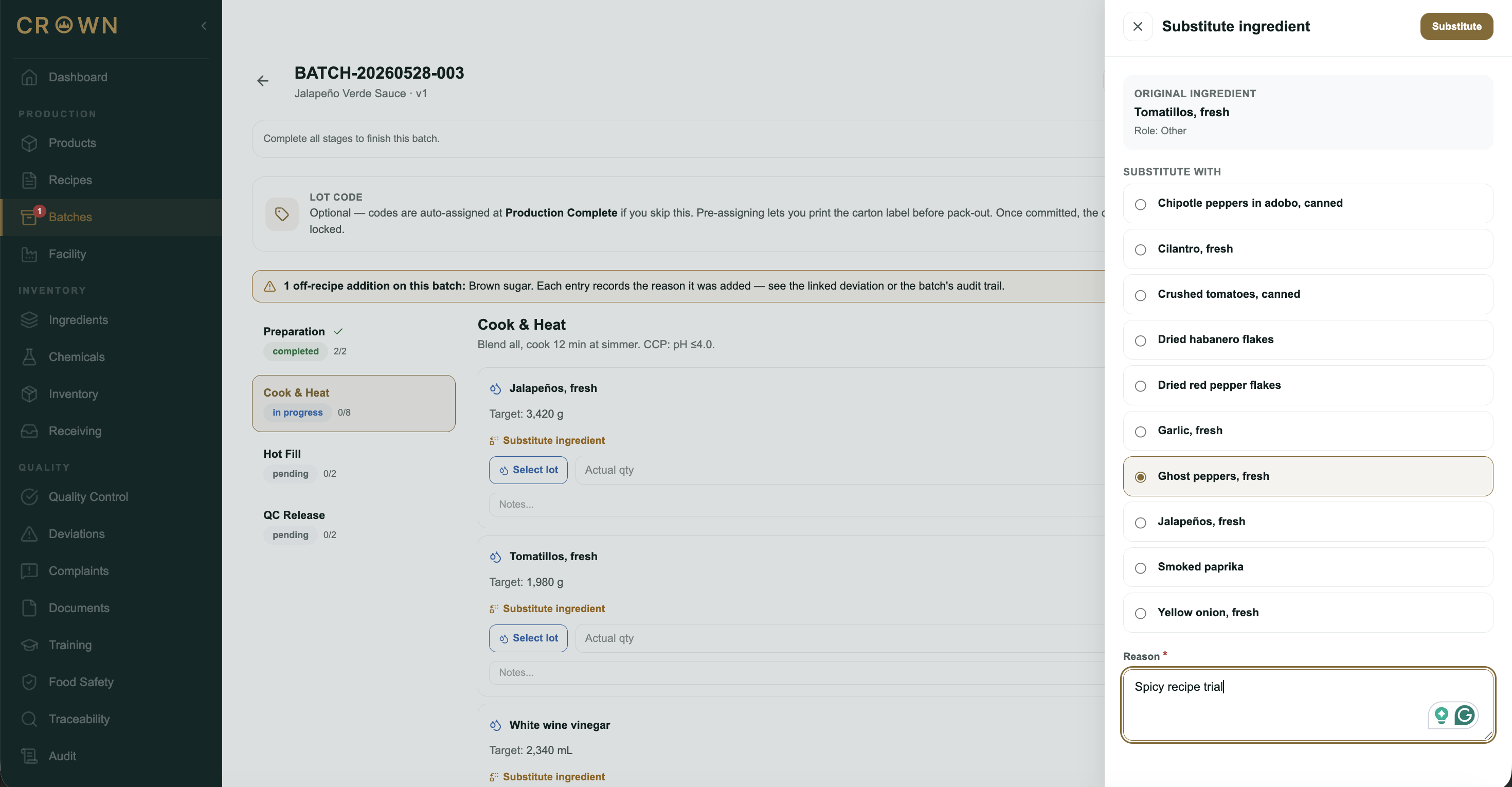
Who appears in the list
Crown only offers stand-ins that can genuinely take the original's place. A candidate has to do the same job in the recipe (water for water, an acid for an acid) and be measured the same way, in the same unit type such as volume. Anything that doesn't match both is left out, and if nothing qualifies the Substitute option is hidden on the item entirely.
If the ingredient you expect isn't offered:
- It isn't in your catalogue yet: receive or add the stand-in first, then substitute.
- It's measured differently: something you track by volume can't stand in for one you track by weight. Check that both use the same measurement type on their ingredient records.
- It's archived: only active ingredients appear.
If a sensible replacement still doesn't show up, update the recipe to include it, or log a deviation and carry on.
Bottled-water swaps and your Water Safety program
Back on the batch, a banner near the top lists each bottled-water substitution affecting the run, with a View in Water Safety Program link straight to the entry.
Quality checks tied to the original are set aside
Substituting in a quick batch
In a quick batch the swap lives on the ingredient's row. Select Substitute to open the same drawer, or Change substitute to pick a different one. Changed your mind before completing? Select Undo to drop the swap and return the row to the original ingredient. While the swap is in place the row is highlighted and labelled Substituted from the original ingredient, and dependent checks are set aside just as they are on the production floor.
When you complete the batch, the summary shows the stand-in with a Substituted from note beside it, next to the recipe's original target, so the finished record reads clearly.
What the record keeps
A substitution never overwrites what the recipe originally called for. The batch record keeps:
- The original ingredient: what the recipe specified, preserved for tracing.
- The substitute and its lots: what you actually used.
- Your reason: why the swap happened.
- Who and when: the person who recorded it, and the time, on the batch's history.
That's what keeps a forward or backward trace, and any recall scoping, reaching the swap instead of missing it.
What's next
For the rest of the batch, see Recording production steps. If no stand-in fits and the change affects the product, see Logging a deviation.