Recipes
Understanding yield
How Crown tracks expected and actual yield: the recipe target, production yield at completion, and accounting for packaged and bulk output.
Yield is how Crown measures what a batch actually produced against what you expected. You set a target on the recipe, and when you complete a batch, Crown compares your real output to that target and to how much you packaged. Tracking yield over time tells you whether your process is consistent and where you're losing product.
Expected yield on the recipe
Every recipe version carries an expected yield, which you can enter two ways:
- As a percentage when you create the recipe (for example,
94), meaning you expect to keep 94% of your batch size as usable output. - As an absolute output in the recipe editor (for example,
940 mLfrom a1000 mLbatch). Crown derives the percentage from this.
Either way, Crown stores an expected output figure for the recipe. That figure is the baseline every batch is measured against.
Production yield
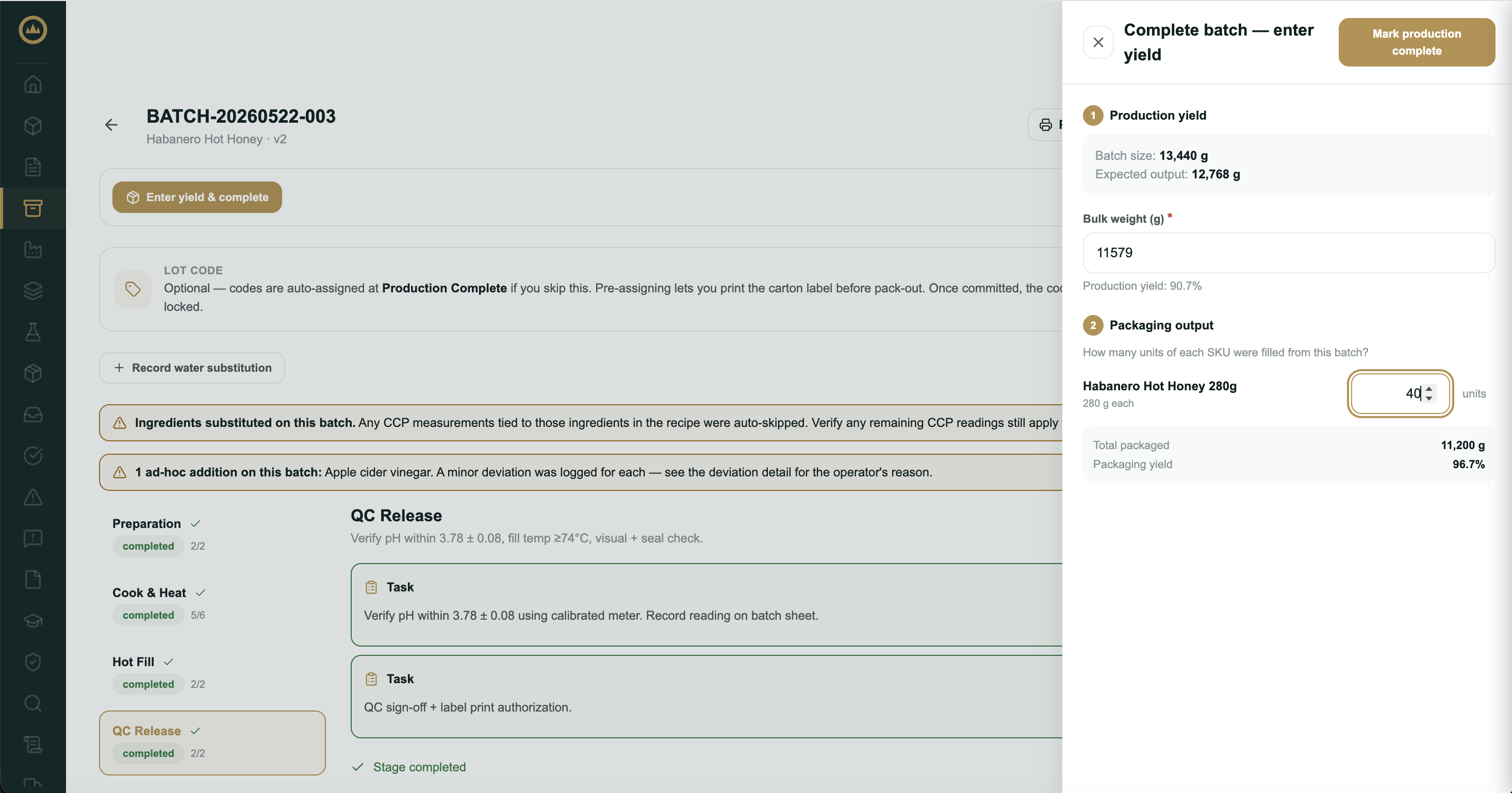
When every stage is complete, select Enter yield & complete. If you measured your bulk output, enter it in Total yield and Crown shows the production yield: your measured output as a percentage of the recipe's expected output. A figure near 100% means you hit your target; well under means you lost more than expected.
Measuring the total is optional. If your process makes it impractical (say, sauce still in the kettle), leave the field blank and Crown takes your output as what you packaged plus anything you left in bulk.
For products measured by count, you don't enter a bulk figure. Crown takes your total output as the sum of the units you filled per SKU.
Output left in bulk
Not everything has to be bottled at completion. If you keep part of your output as bulk to package later, enter that amount in Left in bulk. Crown saves it as its own finished-good lot, and it counts toward the batch's accounted output rather than showing up as loss. When you're ready to bottle it, use the Package action on that lot, from the batch's Output section or from the Finished Goods tab on the Inventory page.
Accounting for your output
If you record packaging in the same step and you entered a measured total, Crown shows how much of that total is Accounted for: your packaged units (each SKU's unit size times the number you filled) plus anything left in bulk, as a percentage of the total you measured. Whatever remains appears as a Loss line.
Why it's worth getting right
Crown compares every batch's actual yield to the recipe's expected output, so the expected figure is your baseline for spotting variance. An inaccurate baseline makes every comparison misleading. If your recipe's expected yield doesn't match what you consistently produce, update it on a new recipe version. See Managing recipe versions.
What's next
Yield is recorded as part of wrapping up a batch. See Releasing a batch for the full path from production complete to released finished goods.