Getting Started
Setting up GTIN-14 carton barcodes
How to add a GTIN-14 to each SKU so your carton labels print a scannable ITF-14 case barcode, and where the number comes from.
A GTIN-14 is the 14-digit number that identifies a shipping case of your product. It's what a distributor or retail warehouse scans when your cartons arrive on their dock. In Crown you enter it once on each SKU, and every carton label you print for that SKU carries it as a scannable ITF-14 barcode. This article covers what the number is, where to get one, and how to enter and print it.
One code for the unit, one for the case
Each SKU (the formats you sell a product in, defined in the product's SKUs section) carries two barcode fields, and they hold different numbers:
- UPC/EAN: the code on the retail unit itself, the barcode a checkout scanner reads on a single bottle or jar. A UPC-A is 12 digits (common in North America); an EAN-13 is 13 digits (most of the rest of the world).
- Carton Barcode (GTIN-14): the code for the shipping case, the barcode a warehouse scanner reads on the outside of the carton. Always 14 digits.
A case of twelve bottles is a different item than one bottle, so it gets its own code. The case code is built from the unit code, though, so once you have a UPC-A or EAN-13 for the unit, the GTIN-14 follows from it (see the anatomy section below).
Getting your numbers
Real barcode numbers are licensed, not invented. You register a GS1 company prefix with your local GS1 member organization: GS1 Canada for Canadian companies, GS1 US for US companies. The licence gives your company a unique prefix and a block of numbers to assign to your products and cases, and it lists your assigned codes in full, check digits included.
That registration matters the moment a case leaves your hands. Distributors, 3PLs, and retailers check case codes against the GS1 registry during vendor onboarding, and a made-up number can collide with another company's product. If your cases move through anyone else's scanning system, use licensed numbers from the start; renumbering cartons after a distributor rejects them is far more painful than registering up front.
Anatomy of the 14 digits
A GTIN-14 has four parts, left to right:
- Indicator digit: the first digit, 1 through 8, identifies the packaging level. Most companies use 1 for their standard case of a product.
- GS1 company prefix: the licensed block that identifies your company.
- Item reference: the digits that identify the product, carried over from your unit code.
- Check digit: the final digit, calculated from the other 13 so scanners can catch misreads.
To turn a unit code into a case code: drop the unit code's final check digit, put an indicator digit in front, add a zero after the indicator if you started from a 12-digit UPC-A (so you have 13 digits before the check digit), then recalculate the check digit.
Take Fieldstone Kitchen, which sells Habanero Hot Honey in a 12-bottle case.
The bottle's UPC-A is 062345678900. Drop the final 0 (the old check
digit), put the indicator 1 in front, and pad with a zero:
1006234567890. Then work out the new check digit:
- Multiply the 13 digits alternately by 3 and 1, starting with 3: (1 × 3) + (0 × 1) + (0 × 3) + (6 × 1) + (2 × 3) + (3 × 1) + (4 × 3) + (5 × 1) + (6 × 3) + (7 × 1) + (8 × 3) + (9 × 1) + (0 × 3) = 93.
- The check digit is whatever brings that total up to the next multiple of 10. The next multiple is 100, so the check digit is 7.
The case code is 10062345678907. Notice the check digit changed from 0
to 7: a GTIN-14 is never just your unit code with a digit stuck on the front.
Entering the code in Crown
- Open the product
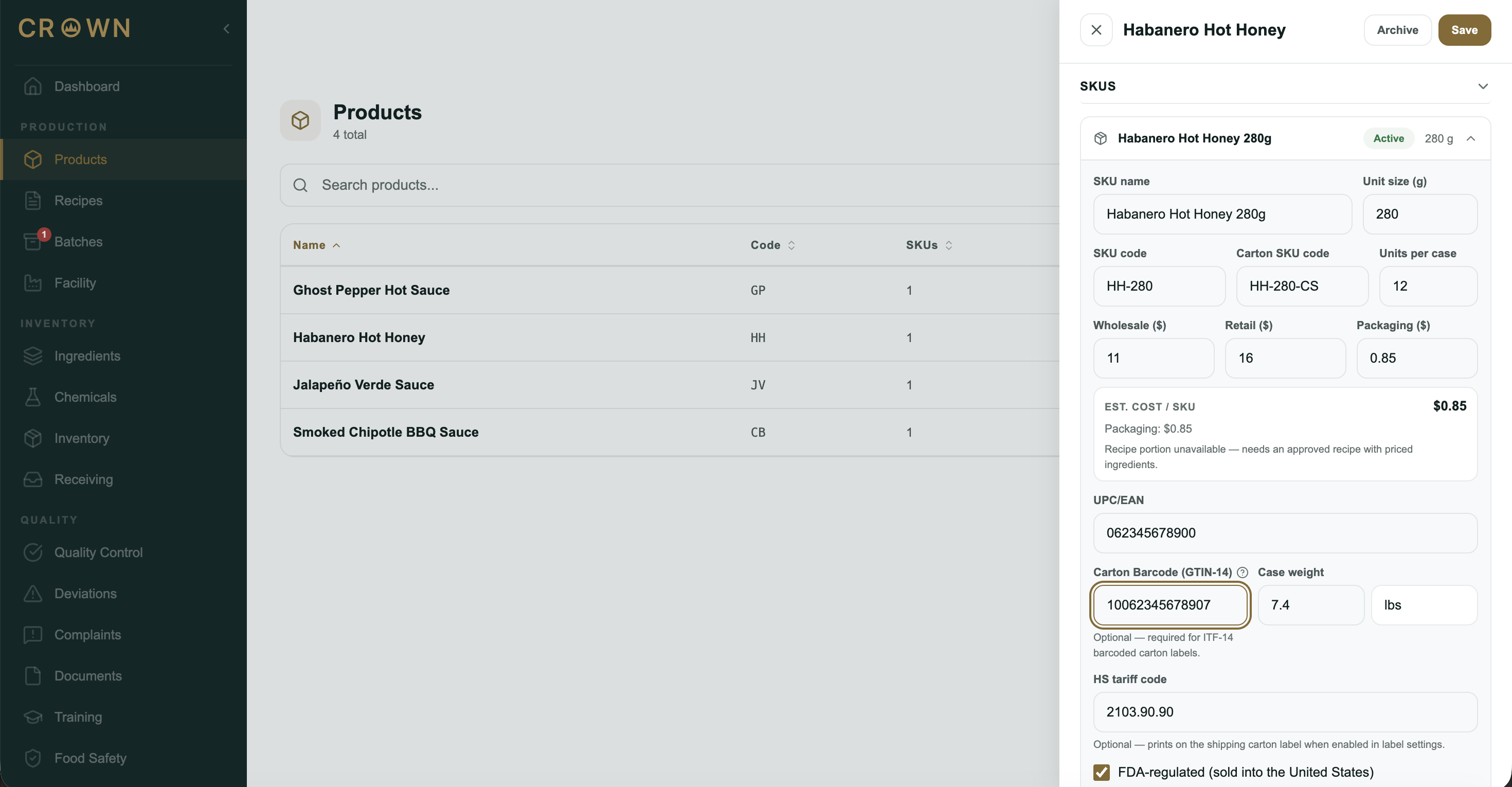
Open Products from the main menu and click the product. The product drawer opens on the right.
- Expand the SKU
In the SKUs section, click the SKU that matches the case you're labelling. Its full editor expands. If the product has no SKUs yet, add one first; see Creating a product.
- Enter the code
Type all 14 digits into Carton Barcode (GTIN-14). While you're there, put the unit's own code in UPC/EAN so both levels are on record.
- Save
Save the SKU. Every carton label you print for this SKU from now on carries the barcode.
Printing the label
Carton labels print from the batch page. Once the batch's lot code has been assigned, a Print Carton Label button appears in the batch header; click it and choose the SKU. Each SKU prints its own label, since case size, weight, and barcode are all SKU-specific.
The label prints the ITF-14 with its heavy black bars above and below (the bearer bars) and the 14 digits beneath, alongside the product name, lot code, SKU identifier, best-before date, and case size. If the SKU has no GTIN-14, the same label prints without the barcode; everything else still appears.
You can preview the layout before ever printing one: in the Admin area, on the Company tab, the Carton label section shows a live preview using your logo and sample data, and sets the label stock size, the best-before date format, and which optional rows (case weight, customs HS code) print. Setting up carton labels walks through those options.
Scan-test before a production run
Two features of the ITF-14 are part of the symbology, not decoration: the bearer bars help scanners read the code cleanly, and the clear space to the left and right of the bars (the quiet zones) is what tells a scanner where the code starts and ends. Crown's label layout includes both, so print the label at full size and don't crop or crowd the barcode when applying it.
When you can skip it
If you sell direct to consumers, at farmers markets, or anywhere nobody scans your cases, leave both the UPC/EAN and Carton Barcode (GTIN-14) fields empty. The carton label still prints with the product name, lot code, best-before date, and case size, which is what matters for your own traceability. If a distributor comes along later, add the codes then; they take effect on the next label you print.
What's next
The carton label pulls its lot code and best-before date from the batch, so Lot code format is the other half of the label setup. And when you're ready to record what actually went into each case, see Packaging and fill records.
Frequently asked questions
Do I need a GTIN-14 to print carton labels in Crown?
No. The carton label prints without a barcode until you add one, and it still carries the product name, lot code, best-before date, and case size. Add the GTIN-14 when a distributor or retailer needs to scan your cases.
What is the difference between the UPC/EAN field and the Carton Barcode (GTIN-14) field?
The UPC/EAN identifies the single retail unit: the barcode on the bottle or jar itself. The GTIN-14 identifies the shipping case. Crown stores both on each SKU, and the carton label prints the GTIN-14.
Can I make up my own GTIN-14?
Only if your cases never leave your own operation. Distributors and retailers check case codes against the GS1 registry during onboarding, so a case that moves through anyone else's warehouse needs a number issued under your own GS1 company prefix.
Does Crown check that my GTIN-14 is valid?
Crown checks that the code is exactly 14 digits, but it does not verify the check digit. Enter the code exactly as it appears on your GS1 certificate and read it back after saving.