GMP & Compliance
Hazard analysis and preventive controls
How to work through a product's process steps in Crown, record hazards and their controls, and mark critical control points.
Hazard analysis is where you work through each step of a product's process and record what could go wrong and how you control it. Crown structures the work, keeps your decisions in one place, and carries them into your PCP document. It lives under Food Safety in the main menu.
Before you start
An approved recipe for the product. Hazard analysis is built around the product's recipe stages plus the standard facility steps (receiving, storage, packaging, shipping, sanitation). A product needs an approved recipe before it appears in the product picker. See Your first recipe.
Working through the steps
Open Food Safety and select a product. Crown lays out its process as a series of steps, each shown as a card with its hazards. You have three ways to handle each step:
- Evaluate hazards: Crown proposes hazards for the step, which you then review.
- Add: author a hazard yourself.
- Mark as controlled: point the whole step at a prerequisite program rather than listing hazards for it individually (for example, a step fully governed by your sanitation program).
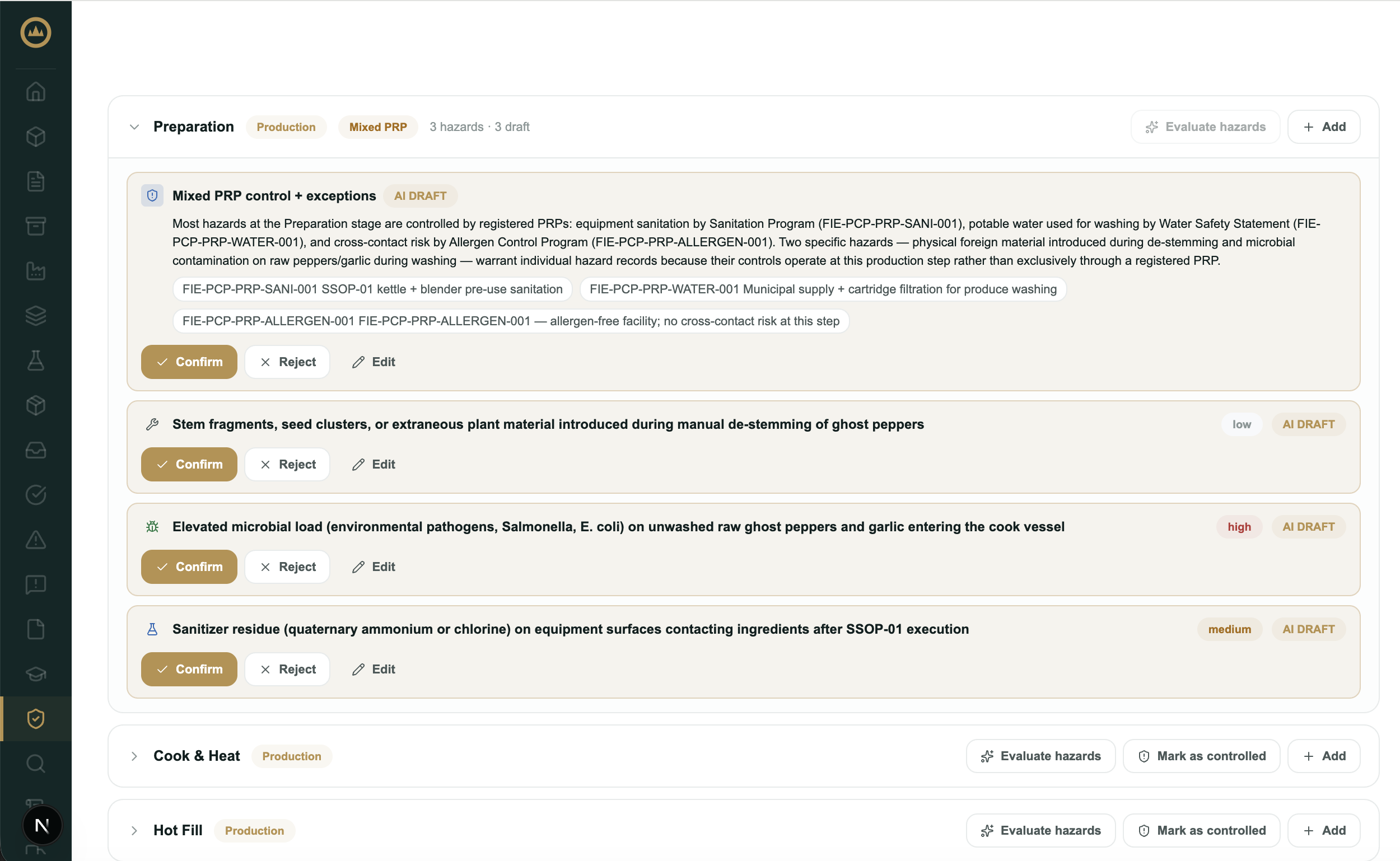
Recording a hazard
When you add or confirm a hazard, you record:
- Category: biological, chemical, or physical.
- Whether it's reasonably likely, with your justification.
- Severity.
- The preventive control, plus how you monitor it, the corrective action if it fails, and the verification activity.
- The responsible role.
A draft hazard becomes part of your plan when you Confirm it. You can Reject a proposed hazard that doesn't apply, with a reason.
Critical control points
A confirmed hazard can be marked as a CCP with a toggle. Crown records the designation and carries it into the preventive controls section of your PCP.
The matrix view
For a product with hazards across many steps, the Matrix view shows them as a single grid of hazard against process step, so you can see where the same concern recurs and confirm or reject related entries together.
What's next
Confirmed hazards and their controls flow straight into your preventive control plan. See Generating your PCP document, and Setting up a prerequisite program for the programs a step can be controlled by.
Frequently asked questions
What is hazard analysis in food production?
Hazard analysis is the process of working through each step of how a product is made and identifying what could go wrong (biological, chemical, or physical hazards) and how each is controlled. In Crown it's organized per product and feeds your preventive control plan.
What is a critical control point (CCP)?
A critical control point is a step where a control is essential to keep a food safety hazard in check. Whether a given hazard is a CCP is a determination you make as the operator; Crown records the designation and carries it into your plan.
Does Crown decide which hazards are critical?
No. Crown can suggest hazards with AI to get you started, but you confirm every hazard and set its likelihood, severity, and CCP status using your own process knowledge. Crown records and organizes those decisions; it does not make them for you.