Production
Lab testing a batch
Sending a batch to an external lab and recording what comes back: labs, QC spec templates, results, automatic pass/fail judging, retests, and trends.
Lab testing proves a batch against your spec before you release it. Crown records the full cycle in one place: the labs you use, the specs you test against, the samples you send, the results as they come back, and the pass or fail call you make on the evidence. This article covers that cycle end to end; for where lab testing sits in the release path, see Releasing a batch.
The Quality Control page
Open Quality Control under Quality in the main menu. The page has four tabs:
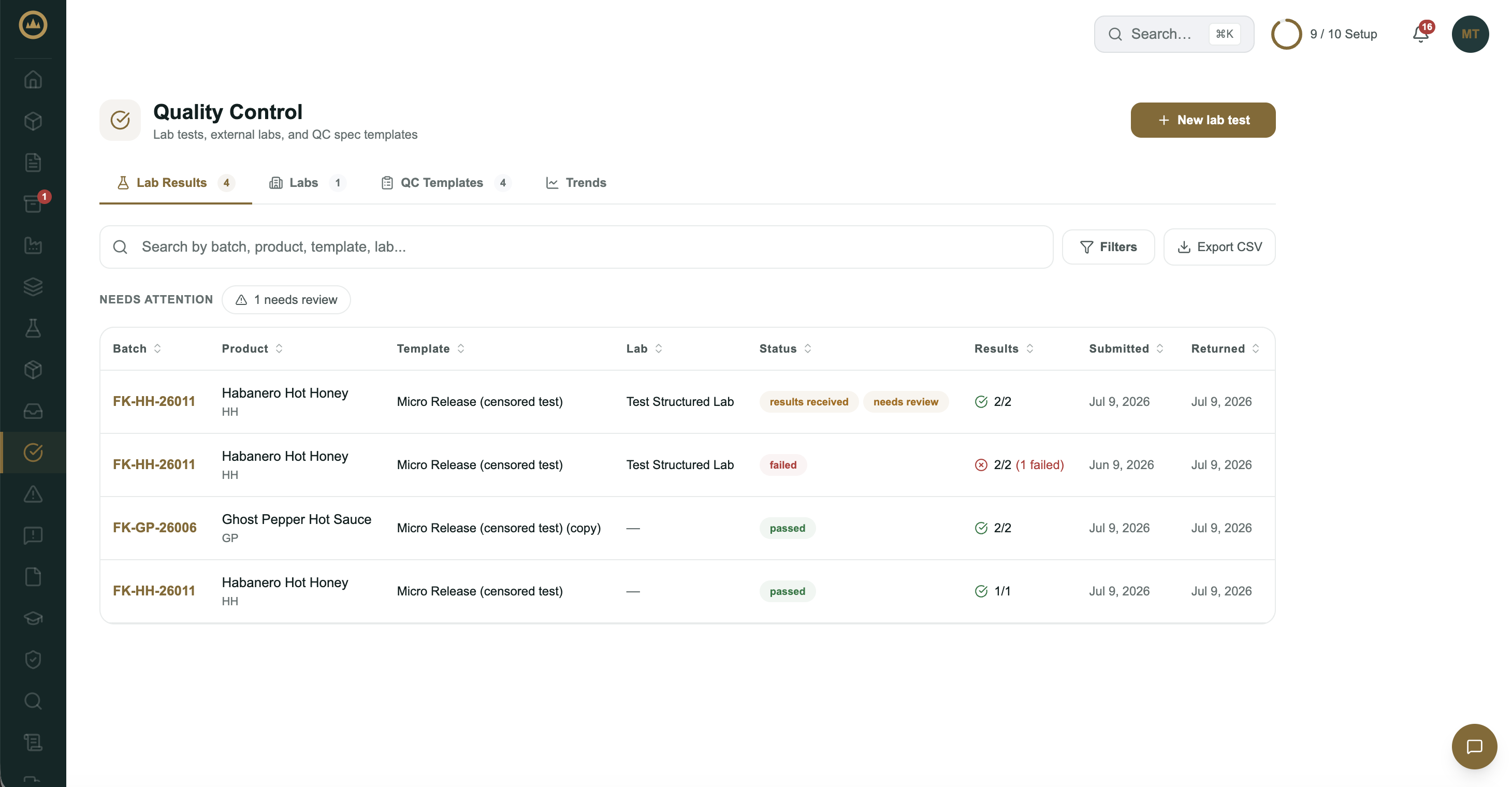
- Lab Results: every lab test across your batches, searchable and filterable, with quick filters for tests that need attention.
- Labs: the external labs you send samples to.
- QC Templates: reusable spec templates that define what a test measures and what counts as passing.
- Trends: any numeric parameter charted across batches.
Selecting a test in Lab Results opens it on its batch's page, so you can work from either end: start on the batch during quality review, or start from this list.
Registering your labs
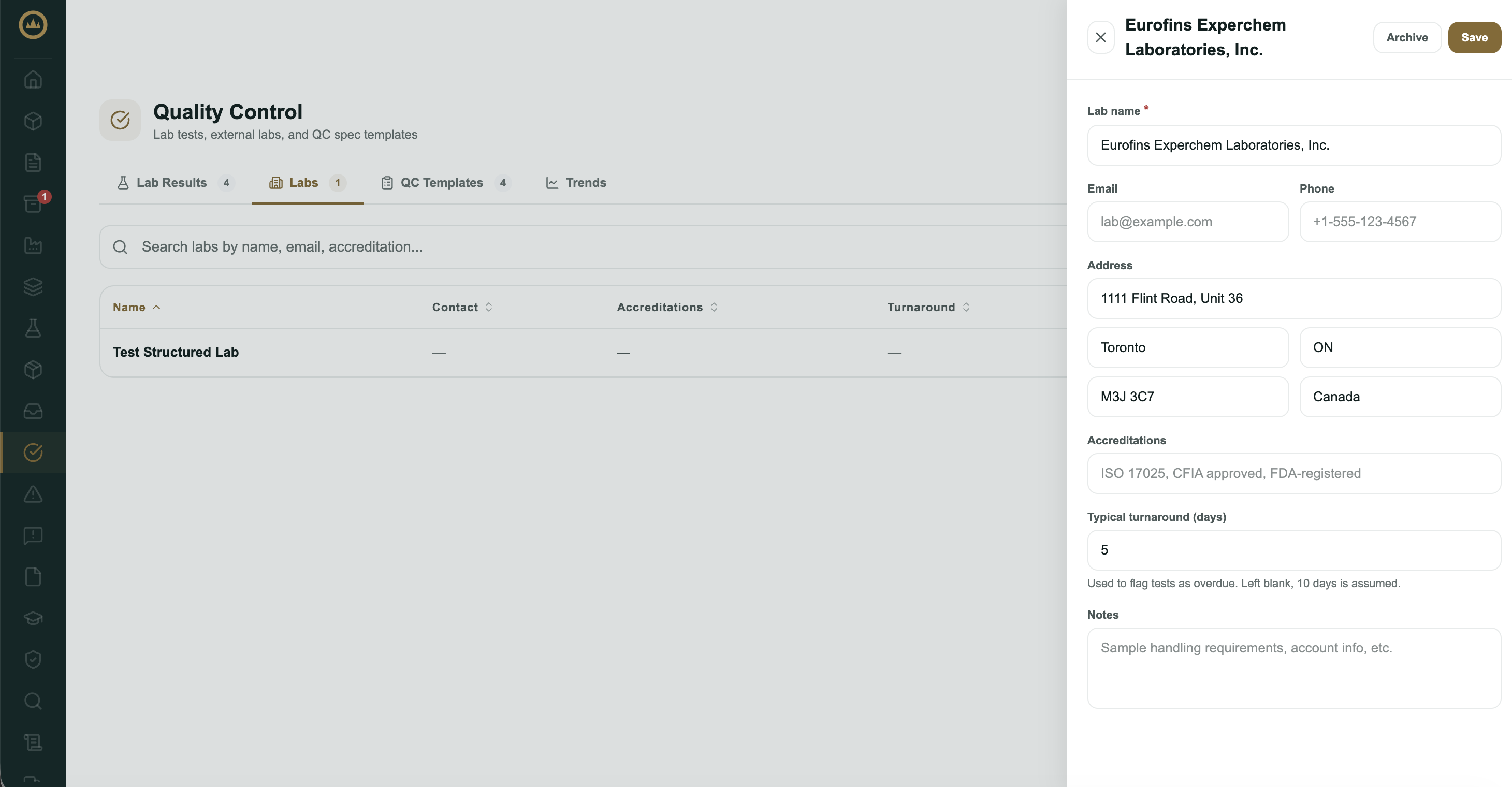
On the Labs tab, select Add lab. Only the lab's name is required, but two fields pay off later:
- Typical turnaround (days): how long this lab usually takes to return results. Crown flags a test as overdue once that many days pass after submission. Left blank, 10 days is assumed.
- Accreditations: free text (ISO 17025, for example) shown beside the lab wherever you pick one, so whoever creates a test can see which lab holds which accreditation.
Contact details, address, and notes round out the record. Archiving a lab hides it from the pickers; tests already tied to it keep their history.
Building QC spec templates
A QC spec template is the spec a test is judged against, defined once and reused. On the QC Templates tab, select New template, name it, and add parameters under Test parameters. Each parameter is one of three types:
- Numeric: a unit and a min/max range, like pH between 3.2 and 3.8. Values inside the range pass.
- Text: a qualitative outcome. Choose Pass = Not detected (or Pass = Detected) and result entry becomes a two-way choice that judges itself; choose Expected: operator decides for free-text results you'll judge yourself.
- Pass/Fail: the lab reports a straight pass or fail.
The Applies to field scopes the template: leave it empty to apply company-wide, or pick one or more products. One template can serve every product that shares a spec, so Fieldstone Kitchen can run the same micro panel on Ghost Pepper Hot Sauce and Jalapeño Verde Sauce from a single template. You can also mark a template as the default for its scope, and Duplicate an existing one to build a variant.
Creating a test
- Start the test
On the Lab Results tab, select New lab test. You can also create one straight from the batch's page during quality review; see Releasing a batch.
- Choose the batch, template, and lab
Only batches that have finished production appear. The template list narrows to specs that apply to the batch's product (plus company-wide ones), and each lab shows its stated turnaround.
- Record the samples
Under Samples from inventory, enter how many units of each SKU you're sending. Each line deducts from the batch's finished goods when the test is created, so units at the lab never count as sellable stock.
- Create the test
Leave the dates blank for a fresh test. The Submitted date and Results received fields are for backfilling a past test into the record.
Entering results
Open the test and enter each value exactly the way the lab reports it:
- Exact reading: keep the comparison on
=and type the number. - Censored reading: when the lab reports a bound instead of an exact
number, pick the comparison and enter the value, like
< 10cfu/g when the count sits below the method's detection limit. Crown keeps the comparison with the number. - Detected / Not detected: parameters with an expected outcome give you a two-way choice.
- Pass / Fail: for parameters the lab adjudicates itself.
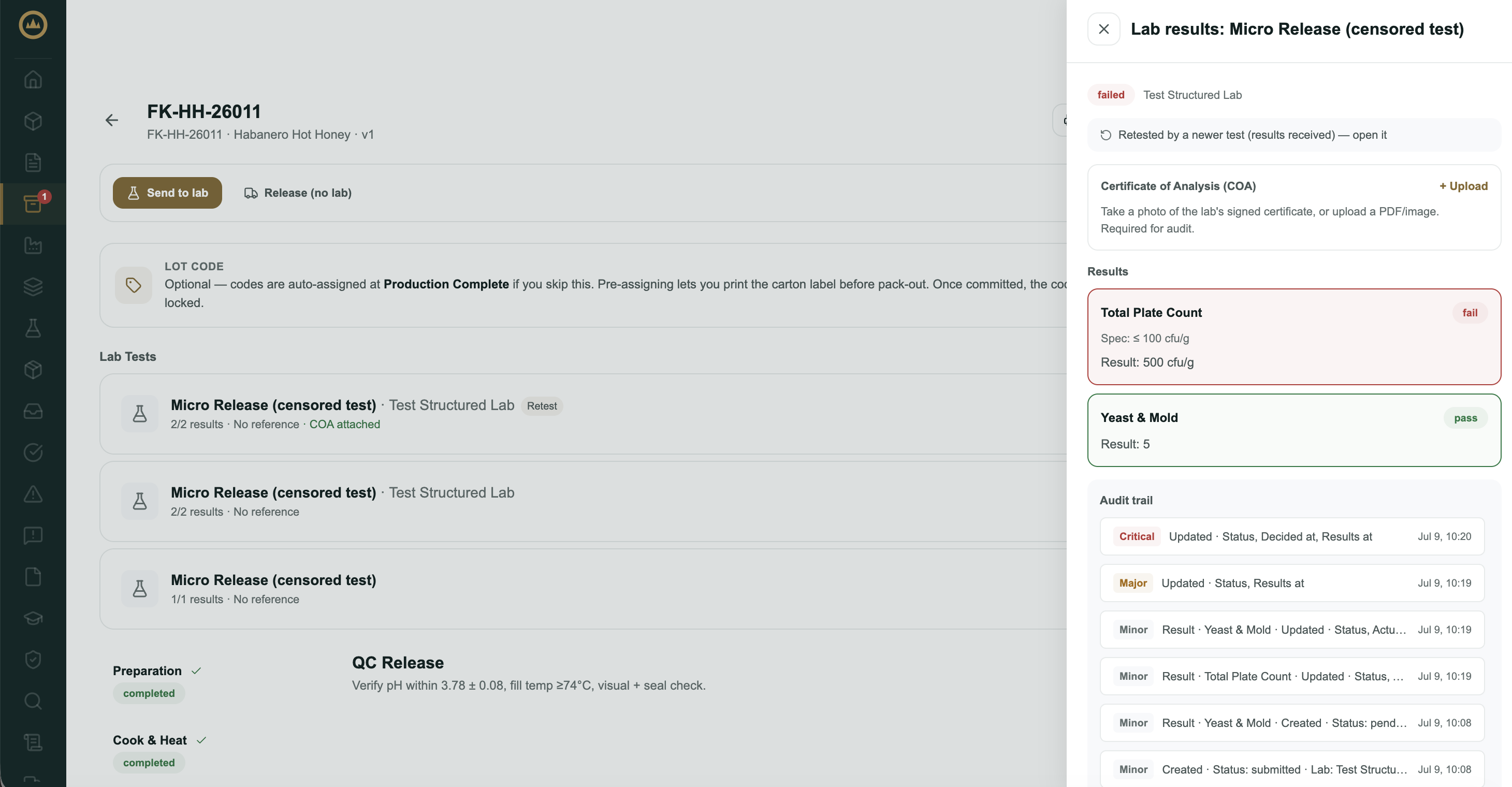
As you enter each value, Crown judges it against the spec and marks it pass, fail, or marginal. Select Save as results trickle in; you don't need the full panel before saving.
Finalizing the test
Once every value is recorded, the Decision panel sums up the results and shows a system recommendation: a clean set of passes recommends a pass, and any fail or marginal routes to review. You make the call by selecting Accept Pass or Accept Fail, or by choosing Pass with Deviation or an override. Overriding the recommendation, or passing with deviation, requires documented reasoning that stays on the test.
To finalize a test as passed, attach the lab's Certificate of Analysis first (photograph it or upload the PDF in the test's Certificate of Analysis (COA) section) or record a reason for passing without it, so every pass is backed by evidence or an explained gap. When the batch's last test is finalized, Crown offers the matching release step on the spot.
Staying ahead of the lab
The Lab Results tab keeps score with a Needs attention strip above the list:
- Awaiting results: tests submitted and waiting on the lab.
- Overdue: the lab's stated turnaround has passed since submission. The row's badge shows how many days over.
- Needs review: a marginal result is waiting on your decision.
Each count is a one-click filter; select it again, or Show all, to clear it.
Correcting a test
Created by mistake: for a test made against the wrong template or created twice, select Archive on the test. It disappears from active lists, its sample quantities return to the batch's finished goods, and the record stays on the test's history. Archiving asks you to confirm and can't be undone from the app.
Finalized with a wrong value: a finalized test is locked. Select Amend, record the reason, and the test unlocks for editing with the reason kept on its history. Finalized tests can't be archived.
Failed and re-running: on a failed or passed-with-deviation test, select Retest. Crown creates a fresh test against the same spec and lab, linked back to the original in both directions, and opens it so you can record the new sample and results. Retest is the correction path when a finalized test needs to be superseded rather than edited.
Spotting drift with Trends
The Trends tab charts one numeric parameter for one product across batches. Pick the product and the parameter: each point is one batch's reading, colored by its pass, fail, or marginal judgment, with the spec range shaded behind the line. Censored readings draw as hollow points. Use it to catch a parameter drifting toward a limit while every individual batch still passes.
What's next
Finalized results feed the release decision; see Releasing a batch. A failed result usually means a deviation to document and resolve; see Logging a deviation.
Frequently asked questions
How does Crown QMS decide whether a lab result passes?
Each parameter on a test carries the spec you defined in its QC template: a numeric range or an expected outcome. As you enter each value, Crown compares it to the spec and marks it pass, fail, or marginal. You always make the final call: Crown shows a recommendation and you accept or override it, with a documented reason for any override.
What is a censored lab result?
A reading the lab reports as a bound rather than an exact number, such as less than 10 cfu/g when the count is below what the method can detect. Crown records the comparison together with the number and judges it against the spec. A censored reading that straddles a spec limit is marked marginal so you can make the call.
Do I need a Certificate of Analysis to pass a lab test?
To finalize a test as passed, attach the lab's Certificate of Analysis to it or record a reason for passing without one. Either way, the decision and its evidence stay on the test's history.